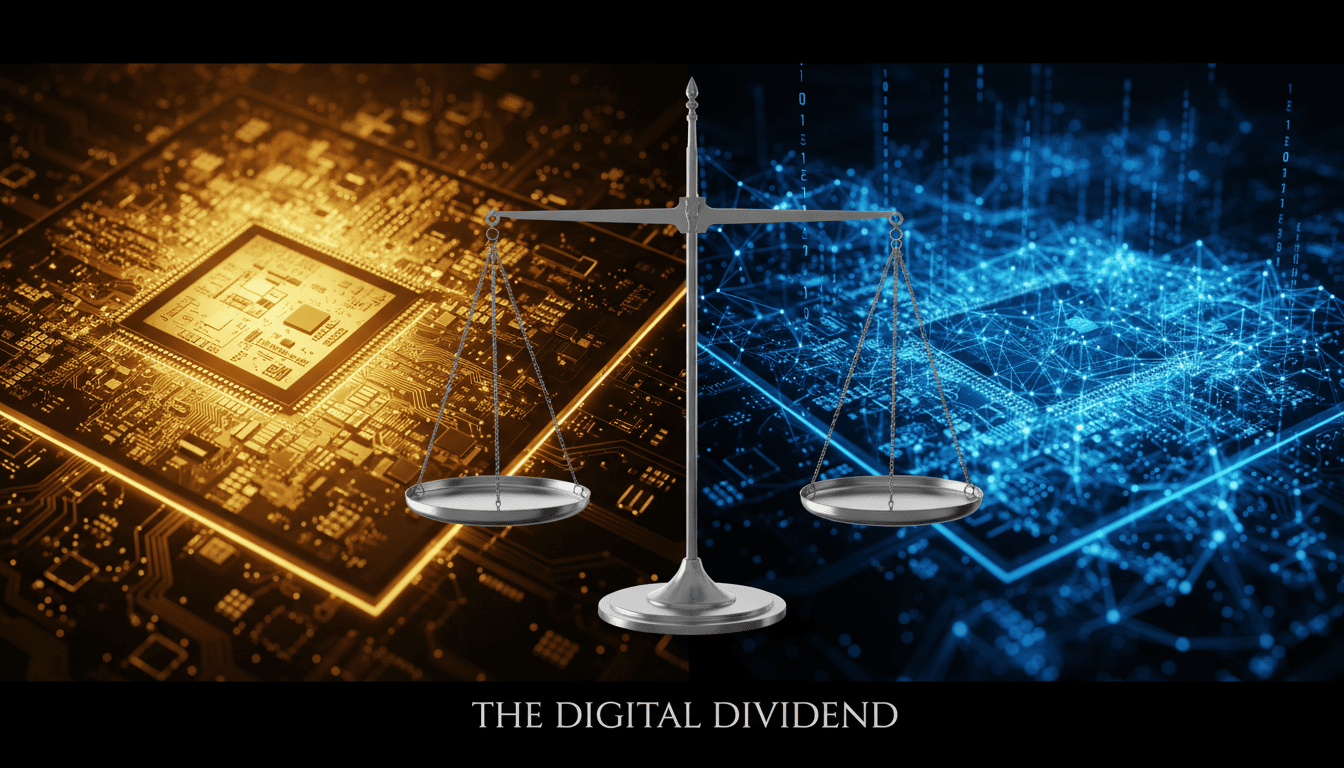
- The Case for Semiconductors: The Infrastructure Moat
- 1. The Tangible Moat of Physics
- 2. The Capital Expenditure (CapEx) Tsunami
- The Downside: Cyclicality and Depreciation
- The Case for Software: The Margin Kings
- 1. Superior Unit Economics
- 2. The Application Layer Explosion
- The Downside: The “Commoditization” Risk
- Comparative Analysis: Where is the Alpha?
- Strategic Allocation: The Barbell Approach
- The 60/40 Split (Current Phase)
- Transitioning for the Future
- Final Verdict
- Related Insights
The Great AI Divergence: Silicon vs. Code
In the financial markets, history rarely repeats itself, but it often rhymes. During the Gold Rush of 1849, the safest fortunes were not made by the prospectors, but by those selling the picks and shovels. In the 2024 AI boom, the Semiconductor industry has firmly established itself as the supplier of these digital picks and shovels. However, the Software sector represents the gold itself—the utility and application of the infrastructure being built.
As investors, we are faced with a critical allocation question: Do we continue to ride the momentum of the hardware infrastructure build-out, or do we position ourselves for the inevitable software super-cycle? This analysis dissects the valuation, risk, and ROI potential of both sectors.
The Case for Semiconductors: The Infrastructure Moat
The current phase of the Artificial Intelligence revolution is defined by Compute Intensity. Large Language Models (LLMs) require a staggering amount of processing power to train and run. This demand has placed semiconductor companies at the top of the food chain.
1. The Tangible Moat of Physics
Unlike software, which can be written by a teenager in a basement, high-end semiconductors are constrained by the laws of physics and the complexities of extreme ultraviolet lithography (EUV). Companies like TSMC (manufacturing) and ASML (equipment) possess what we call ‘wide economic moats.’
- High Barrier to Entry: Building a modern foundry costs upwards of $20 billion. This creates a natural oligopoly, protecting margins for established players.
- Supply Constraints: In the short-to-medium term, demand for AI-ready GPUs outstrips supply, granting pricing power to designers like Nvidia and AMD.
2. The Capital Expenditure (CapEx) Tsunami
We are currently witnessing a massive CapEx cycle from the ‘Hyperscalers’ (Microsoft, Google, Amazon, Meta). They are pouring hundreds of billions of dollars into data center infrastructure. For the semiconductor investor, this is a direct transfer of wealth from Big Tech’s bank accounts to the revenues of chipmakers.
The Downside: Cyclicality and Depreciation
However, prudence dictates we acknowledge the risks. The semiconductor industry is historically cyclical. Once the initial training infrastructure is built, will the demand for chips plateau? Furthermore, fabrication plants depreciate rapidly. A hardware company must constantly reinvest massive amounts of capital just to maintain its position, dragging down Free Cash Flow (FCF) compared to software peers.
The Case for Software: The Margin Kings
If semiconductors are the engine, software is the fuel. The bullish argument for software lies in its economic efficiency and scalability.
1. Superior Unit Economics
The beauty of the Software-as-a-Service (SaaS) model is the marginal cost of replication. Once code is written, selling it to the millionth customer costs almost nothing. This leads to:
- Gross Margins: typically 75% to 90%, compared to 50% to 65% for hardware.
- Recurring Revenue: Subscription models provide predictable cash flows, which Wall Street rewards with higher valuation multiples.
2. The Application Layer Explosion
We are moving from the ‘Training’ phase to the ‘Inference’ and ‘Application’ phase. As the cost of compute drops (thanks to better chips), the viability of AI software increases. We are looking for companies that integrate AI to create ‘stickiness’—making their product indispensable.
The Downside: The “Commoditization” Risk
The primary risk for AI software is that AI becomes a commodity. If everyone has access to the same foundational models (like GPT-4 or Llama 3), where is the competitive advantage? Software companies must prove they have unique proprietary data to train their specific AI, or they risk having their margins compressed by competition.
Comparative Analysis: Where is the Alpha?
| Metric | Semiconductors (Hardware) | AI Software (SaaS) |
|---|---|---|
| Primary Revenue Driver | Unit Sales (Volume x Price) | Subscriptions (ARR) |
| Capital Intensity | High (Factories, R&D, Supply Chain) | Low (R&D, Sales & Marketing) |
| Gross Margins | Moderate (50-65%) | High (70-90%) |
| Economic Moat | Manufacturing Complexity, IP | Network Effects, Switching Costs |
| Current Valuation Risk | High (Priced for perfection) | Moderate (Recovering from 2022 lows) |
Strategic Allocation: The Barbell Approach
For the prudent investor, betting the house on one side of this equation is reckless. I recommend a Barbell Strategy tailored to the current maturity of the AI cycle.
The 60/40 Split (Current Phase)
Currently, we are still in the infrastructure build-out. Therefore, a portfolio weighted 60% towards Semiconductors captures the immediate CapEx spending. This portion should focus on the ‘Pick and Shovel’ leaders—the foundries and the designers.
The remaining 40% should be allocated to High-Conviction Software. These are not speculative startups, but established platforms with vast proprietary data sets (e.g., enterprise resource planning, financial data, cybersecurity) that can upsell AI features without increasing customer acquisition costs.
Transitioning for the Future
As we approach 2026-2027, the infrastructure build-out will likely normalize. At this point, the alpha will shift. The savvy investor will begin rotating profits from semiconductor winners into the software layer, flipping the ratio to favor applications as they begin to monetize the installed base of compute power.
Final Verdict
Invest in Semiconductors for immediate growth driven by scarcity and infrastructure build-out. Invest in Software for long-term compounding, margin expansion, and stability. In a market defined by disruption, the only losing strategy is failing to participate in both.