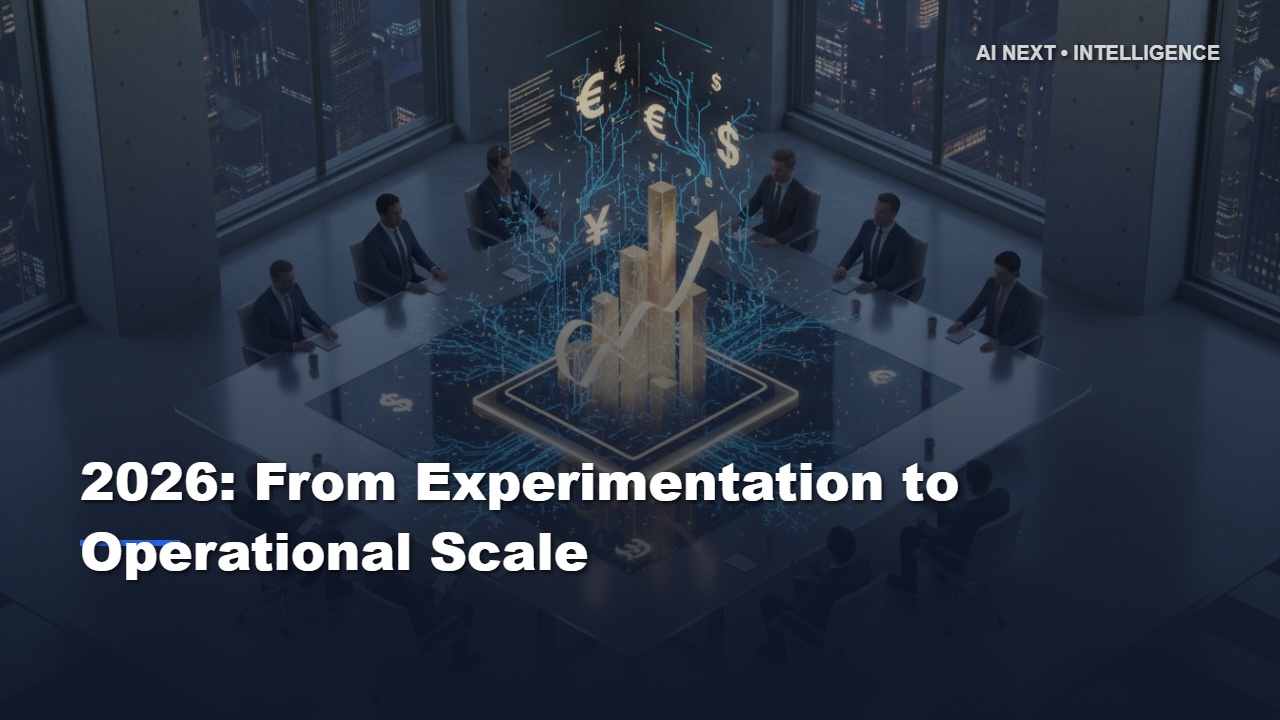
Enterprise AI Budget Projections 2026: The Capital Allocation Shift
By fiscal year 2026, corporate AI adoption will cease to be an “innovation” line item and will restructure the fundamental architecture of IT budget allocation. The era of unbridled pilot programs is ending; the era of ROI-mandated operationalization has begun.
Strategic Outlook 2026
Core Projection: Enterprise AI spending is forecast to transition from CapEx-heavy infrastructure build-outs to OpEx-driven inference management and governance. Projections indicate a 35% Compound Annual Growth Rate (CAGR) in AI-specific IT budgets through 2026.
Key Driver: The migration from monolithic Large Language Models (LLMs) to domain-specific Small Language Models (SLMs) and Agentic Workflows.
The 2026 AI Spending Forecast
Current enterprise technology trends suggest that 2026 will mark the stabilization point for Generative AI. While 2023-2024 focused on acquisition (hardware and foundation model licenses), 2026 budgets will prioritize integration, observability, and security.
Redefining IT Budget Allocation 2026
CIOs and CFOs must anticipate a distinct fracture in traditional software spending. Standard SaaS budgets will likely contract as funds are diverted to consumption-based AI pricing models. The primary cost centers will shift as follows:
- Inference & Compute: Moving from training costs to runtime inference costs as applications go into production.
- Data Sovereignty: Significant investment in private clouds and on-premise infrastructure to mitigate IP leakage risks.
- AI Governance: Compliance software and legal consultation to manage the EU AI Act and emerging global regulations.
Comparative Analysis: 2024 vs. 2026 Budget Composition
The following data illustrates the structural change in corporate AI adoption spending dynamics.
| Budget Category | 2024 Allocation Strategy | 2026 Projected Allocation |
|---|---|---|
| Primary Funding Source | Innovation / R&D Funds | Core IT Operations (OpEx) |
| Model Architecture | General Purpose LLMs (GPT-4 class) | Hybrid (SLMs + Agentic Systems) |
| Talent Spend | AI Researchers / Data Scientists | AI Engineers / Ethics Compliance |
| Success Metric | Proof of Concept (PoC) Volume | Revenue per Employee / Efficiency |
The “Shadow AI” Liability Factor
A critical component of the AI spending forecast involves mitigating “Shadow AI”—unsanctioned use of AI tools by employees. By 2026, enterprises are expected to allocate up to 15% of their security budgets specifically toward AI firewalling and prompt injection defense mechanisms.
“The defining characteristic of the 2026 enterprise AI budget will not be how much is spent on compute, but how much is spent on the observability layer to prove the compute was worth it.”
For decision-makers, this necessitates a rigorous audit of current technology stacks. The integration of agentic AI—autonomous systems performing multi-step workflows—will require substantially higher inference budgets than the chatbot interfaces prevalent in 2024.
Executive Takeaway
To prepare for the 2026 fiscal landscape, organizations must move beyond the hype cycle. Strategic capital planning requires a pivot toward sustainable infrastructure, heavily weighted on inference efficiency and data hygiene. The winners will not be those who spend the most on models, but those who spend the wisest on integration.