- The Strategic Landscape: Hegemony vs. Insurgency
- NVIDIA: The Blue Chip Standard
- AMD: The Value-Add Challenger
- Hardware Economics: The H100 vs. MI300X
- The “VRAM” Arbitrage
- The Software Moat: Evaluating the “CUDA Tax”
- The PyTorch Abstraction
- Total Cost of Ownership (TCO) Modeling
- 1. Acquisition Cost (CAPEX)
- 2. Operational Expenditure (OPEX)
- 3. The Opportunity Cost of Availability
- Supply Chain & Vendor Lock-In Risks
- The Role of Cloud Intermediaries
- Conclusion: The Verdict for the Enterprise
- Related Insights
Enterprise GPU Solutions: NVIDIA vs AMD for Business ROI
By Marcus Sterling | Financial Analyst & Investment Strategist
The era of experimental AI is over. We have entered the phase of industrialization. For the CTO and the CFO, this transition shifts the focus from feasibility to unit economics. When a single server rack costs as much as a prime real estate asset, the selection of the underlying silicon—the Graphical Processing Unit (GPU)—becomes a strategic capital allocation decision, not just a hardware spec check.
For the last decade, NVIDIA has enjoyed a practically unchallenged monopoly in the data center. Their stock valuation reflects this hegemony. However, market forces abhor a vacuum. AMD has emerged not just as a discount alternative, but as a technically potent rival capable of disrupting the Total Cost of Ownership (TCO) calculus for enterprise AI.
This guide analyzes the duopoly through a prudent, ROI-focused lens. We are stripping away the marketing hype to look at memory bandwidth per dollar, software migration friction, and supply chain resilience.
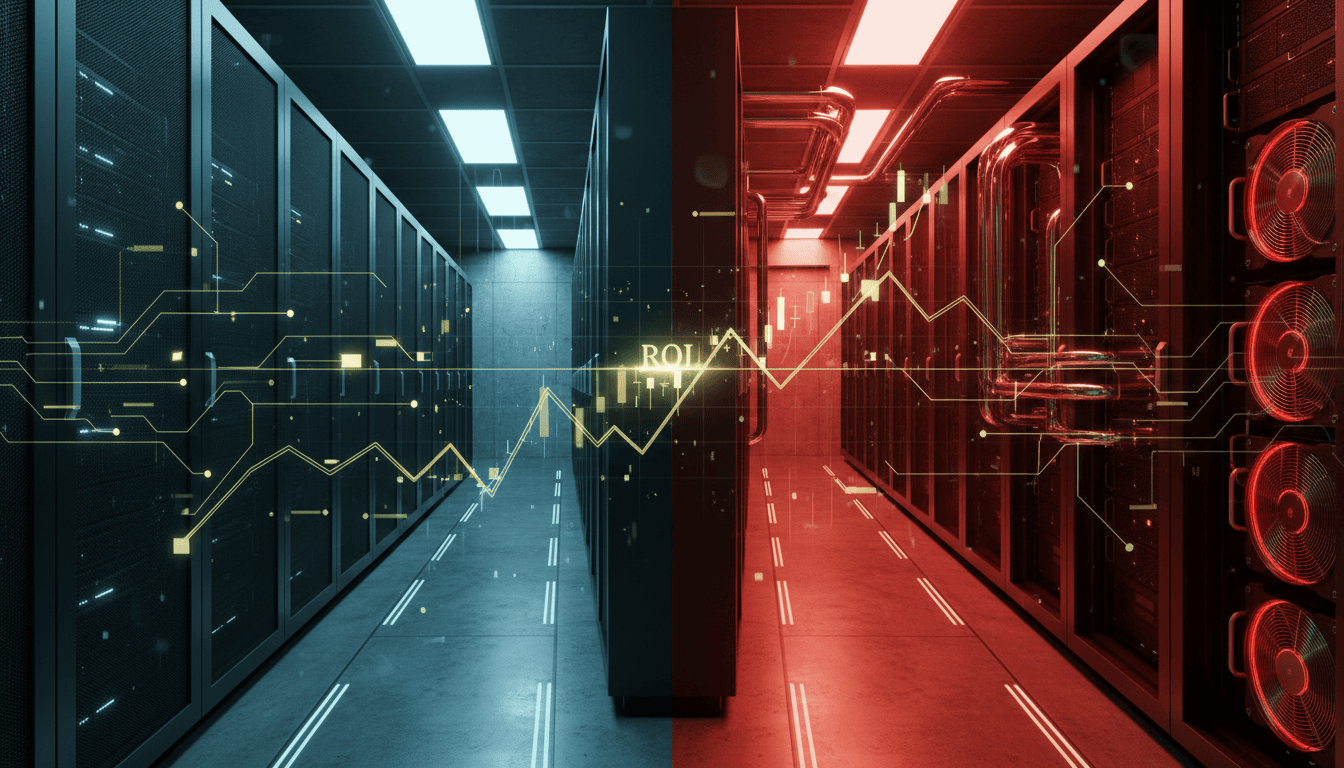
The Strategic Landscape: Hegemony vs. Insurgency
To understand the purchasing decision, one must understand the market positioning. NVIDIA is the incumbent utility provider; AMD is the agile disruptor.
NVIDIA: The Blue Chip Standard
NVIDIA’s dominance is built on a vertically integrated stack. When you buy an H100 (Hopper) or the upcoming B200 (Blackwell), you aren’t just buying silicon. You are buying into the NVLink interconnect technology, the InfiniBand networking, and most critically, the CUDA software ecosystem.
The Financial Implication: Choosing NVIDIA is the risk-averse play. It guarantees compatibility with 99% of existing AI research repositories. However, it commands a significant premium—often 3x to 4x the manufacturing cost—and subjects the enterprise to severe supply constrained allocation (coined “The GPU Squeeze”).
AMD: The Value-Add Challenger
AMD’s strategy with the Instinct MI300 series is classic asymmetric warfare. They cannot beat NVIDIA on entrenched software history, so they are attacking on raw hardware economics: more memory, faster bandwidth, and an open-standard approach to interconnects.
The Financial Implication: Adopting AMD represents a higher initial friction (engineering time to validate software compatibility) in exchange for a significantly higher long-term ROI, particularly for inference-heavy workloads.
Hardware Economics: The H100 vs. MI300X
In high-performance computing (HPC), time is money, but memory is throughput. The limiting factor for modern Large Language Models (LLMs) like GPT-4 or Llama 3 is often not how fast the chip calculates, but how fast it can move data into memory.
| Feature | NVIDIA H100 (SXM) | AMD Instinct MI300X | Business Impact |
|---|---|---|---|
| Memory Capacity | 80GB HBM3 | 192GB HBM3 | AMD can fit larger models on fewer chips, reducing server count. |
| Memory Bandwidth | 3.35 TB/s | 5.3 TB/s | Higher bandwidth = faster inference tokens per second. |
| Approx. Market Price | $25,000 – $40,000 | $15,000 – $20,000 | AMD offers ~40% lower CAPEX at the unit level. |
| Interconnect | NVLink (Proprietary) | Infinity Fabric (Open) | NVIDIA locks you into their ecosystem; AMD allows more flexibility. |
The “VRAM” Arbitrage
Note the discrepancy in memory capacity. The MI300X offers nearly 2.4x the memory capacity of the standard H100. For a business running a 70-billion parameter model, this is the difference between needing two H100s (daisy-chained) or a single MI300X.
By consolidating workloads onto fewer GPUs, you save on:
- Chassis costs: Fewer physical servers required.
- Networking costs: Reduced need for expensive InfiniBand cabling.
- Energy costs: Less idle silicon drawing power.
The Software Moat: Evaluating the “CUDA Tax”
Here lies the crux of the investment thesis. NVIDIA’s CUDA (Compute Unified Device Architecture) is the operating language of AI. It has a 15-year head start. AMD’s alternative, ROCm (Radeon Open Compute), has historically been buggy and difficult to implement.
However, the landscape changed in late 2023.
The PyTorch Abstraction
Most enterprise AI development is no longer done in raw CUDA C++. It is done in high-level frameworks like PyTorch or TensorFlow. With the release of PyTorch 2.0, the abstraction layer has improved dramatically. For many standard workloads (LLM inference, fine-tuning), the code runs on AMD hardware with minimal changes.
Investment Strategy: If your organization is building novel, bleeding-edge neural network architectures, the “CUDA Tax” is a necessary cost of doing business. You need NVIDIA. If your organization is taking off-the-shelf models (like Llama 3 or Mistral) and serving them to customers, the CUDA premium is wasted capital. AMD is sufficient.
Total Cost of Ownership (TCO) Modeling
As a financial analyst, I advise looking beyond the purchase order price. We must calculate the 3-year TCO.
1. Acquisition Cost (CAPEX)
A standard HGX H100 server (8 GPUs) can cost upwards of $300,000 to $400,000 depending on the integrator. A comparable AMD instinct platform may retail for $220,000. That is an immediate $100k+ delta per node.
2. Operational Expenditure (OPEX)
Power density is the hidden killer. Both chips push the thermal envelopes of modern data centers, often requiring liquid cooling. While AMD chips can draw more raw power, their higher performance-per-watt in inference tasks means they finish jobs faster, entering low-power idle states sooner.
3. The Opportunity Cost of Availability
This is the metric most CFOs miss. If you choose NVIDIA, you may face a 40-week lead time. That is 40 weeks your product is not in the market. AMD, having a more diversified supply chain (utilizing Chiplet technology at TSMC), generally offers significantly shorter lead times.
What is the cost of delaying your AI roadmap by three quarters?
Supply Chain & Vendor Lock-In Risks
Diversification is a core tenet of portfolio management. It should also be a tenet of infrastructure management.
Relying 100% on NVIDIA creates a single point of failure. We have seen price hikes and allocation restriction tied to geopolitical tensions. Building a “Hybrid Compute” strategy—where training occurs on NVIDIA (Cloud) and inference occurs on AMD (On-Prem)—hedges against vendor price gouging.
The Role of Cloud Intermediaries
Major cloud providers (Azure, AWS, Oracle) are now deploying MI300X instances. This allows enterprises to test the AMD waters without capital commitment. A prudent strategy involves a 3-month pilot on cloud-based AMD silicon to validate software compatibility before committing to a CAPEX purchase of hardware racks.
Conclusion: The Verdict for the Enterprise
The decision between NVIDIA and AMD is no longer about “Best vs. Second Best.” It is about “Specialized vs. Generalized.”
Buy NVIDIA (H100/Blackwell) if:
- Your core business is training foundation models from scratch.
- Your engineering team relies on legacy CUDA libraries that have no ROCm equivalent.
- Budget is secondary to reduced engineering friction.
Buy AMD (MI300X) if:
- Your primary workload is inference (running models for users).
- You are deploying open-source models (Llama, Falcon, Mistral).
- You are sensitive to TCO and require maximum memory density per server rack.
- You wish to mitigate supply chain lead times.
In the financial analysis of AI infrastructure, NVIDIA is the safe, expensive bond; AMD is the high-yield growth equity. A balanced portfolio likely requires exposure to both.